Ask any service business what something costs and you will hear the same two words: it depends. The caterer's price depends on the guest count, the kitchen, the dietary spread, and whether the venue allows open flame. The photographer's depends on the hours, the locations, and how much editing the final set will need. The consultant's depends on what discovery turns up and how much of the problem the client has actually admitted to. Behind every it depends sits a tree of dependencies that a human spent a career learning. Some of it makes it into an SOP, the process, the steps, the checklist. The nuance never does. When the rule bends, for whom, by how much, in which month, at what price: that lives in heads, and it walks out the door at five o'clock. Services make up most of the economy, which makes this the biggest body of commercial knowledge on earth that no machine can read.
The internet digitized products first because products are the easy case. A product submits to complete description, this object, this price, this many in stock, so it fits a buy-now button, and a trillion dollars of infrastructure grew up around the button. A service has never fit it. There is no finished description of an offsite, an audit, a shoot, or a dinner for eighty; the description gets produced jointly, through a conversation shaped by constraints that are mostly unwritten. Products are selected. Services are scoped. The whole modern stack was built for the first verb, and the second one still runs on contact forms, phone tag, and PDFs.
Watch a good operator qualify a job and the same thing happens in every corner of the industry. The caterer asks about the kitchen before the menu. The videographer asks how many rounds of revisions before he names a number. The advisory firm asks who else has looked at the problem before agreeing that the problem exists. Each question is the fossil of a past disaster, a job that died or a margin that evaporated for the lack of that exact answer. Expertise in services is via negativa, knowing what to turn down, and why, and when the refusal softens. That part took years and real losses to learn.
Software has tried. Marketplaces flattened service businesses into categories and star ratings. Booking tools captured whatever was measurable, availability, price, a dropdown of package sizes, and operators ignored them and kept answering the phone, because the part that mattered never fit inside a form.
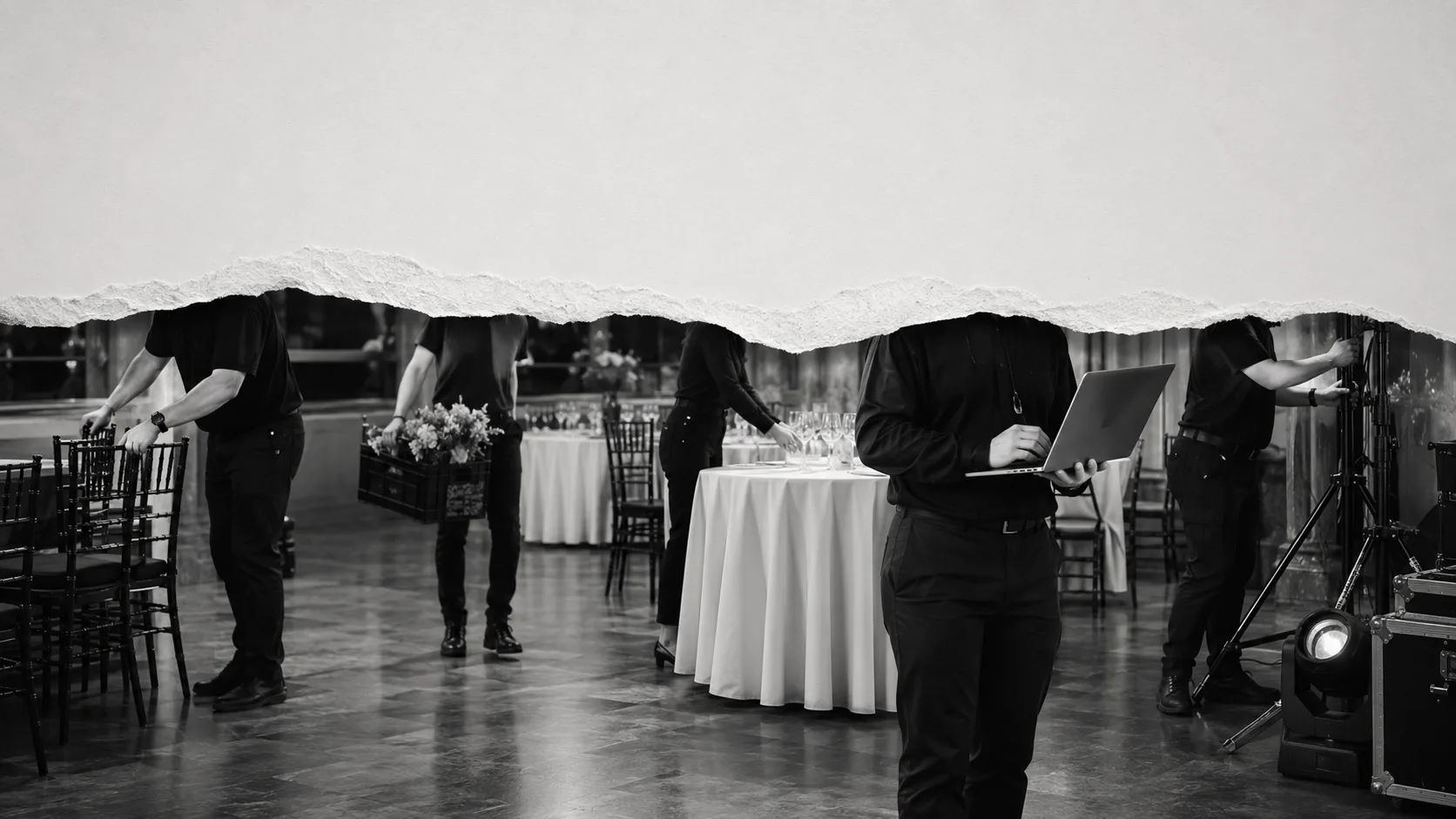
Headless is a borrowed word. In commerce it meant separating the storefront from the engine underneath, so the same inventory could sell through any surface. In services the head is literal. Every service business is a body of genuine capability, kitchens, crews, cameras, licenses, taste, judgment, fronted by one or two human heads running the same interrogation on every inbound lead, the same forty questions, thousands of times over a working life. Making a business headless means handing that interrogation to machines, so the business can be scoped, quoted, and booked at any hour and in any volume, without its owner in the room. Nothing about the actual work changes hands. The chef still cooks, the crew still rigs, the strategist still sits across the table for the conversations that matter. What leaves the head is the bottleneck, and the bottleneck was never the part anyone loved.
The reason this matters now is that the buyers are changing faster than the sellers. Payment networks are teaching software agents to spend money, the rails are live, and within a few years a meaningful share of demand will arrive as an agent with a mandate and a wallet rather than a person with a phone. An agent that can pay for anything and scope nothing is a drunk with a credit card. Products forgive bad transactions with a returns policy; services punish them with real-world wreckage, the offsite locked in before anyone asked about power or load-in, the engagement signed before anyone agreed what finished looks like. The world is getting agents that can pay before it gets agents that can understand, and understanding is the problem we chose.
This is the work Libramen exists to do. We sit between the agents and the real world, teaching machines to carry the conversation that services have always required, so that when an agent arrives with a brief it meets a business's actual judgment rather than a contact form. How we do it is a matter for the product, and the mechanics will keep evolving as the work matures. The commitments underneath will not: the business stays in control of what it knows, and nothing gets promised on its behalf that it would never have promised itself.
Scoping is one of the oldest activities in commerce. The merchant in the souk did exactly this work for four thousand years, sizing up the buyer, asking the eliminating questions, refusing what lay beyond his means or beneath his craft. What changes now is the counterparty and the clock: the next buyer is an agent, arriving at machine speed and in machine volume, and no head can stand beside the stall for that.
The mission is to make the entire service economy headless, so every business whose real product is judgment applied to circumstances can meet the next generation of demand without standing at the counter for it. A world where the knowledge of millions of operators outlives the people who earned it, where a two-person outfit greets agentic customers on the same footing as the largest firm, and where every business whose honest answer has always been it depends can finally give that answer completely, the moment it is asked. Your next customer is an AI agent. When it arrives, it should meet everything you know, and none of your phone tag. That is what headless means, and it is why we are building Libramen.